
Submit valid payment claims
The only software built from the ground up for subcontractors and main contractors to comply with the Building Industry Fairness (Security of Payment) Act 2017 (Qld).
A substantial portion of payment claims are found to be invalid
A substantial portion of payment claims in Queensland are found to be invalid at adjudication or in court.
So even where a claimant has a legitimate claim to money, a respondent can avoid liability to pay it on the ground that the claim did not comply with the BIF Act.
Queensland, by year of decision
11 years since 2015 average 34%. Counted from published Queensland adjudication decisions. A decision counts as nothing where the adjudicated amount is nil, which is not always a jurisdictional finding. 2026 is excluded because decisions for it are still being published.
What Paystruct serves
Every page below is the app’s own output, produced from a worked example rather than drawn for a website.
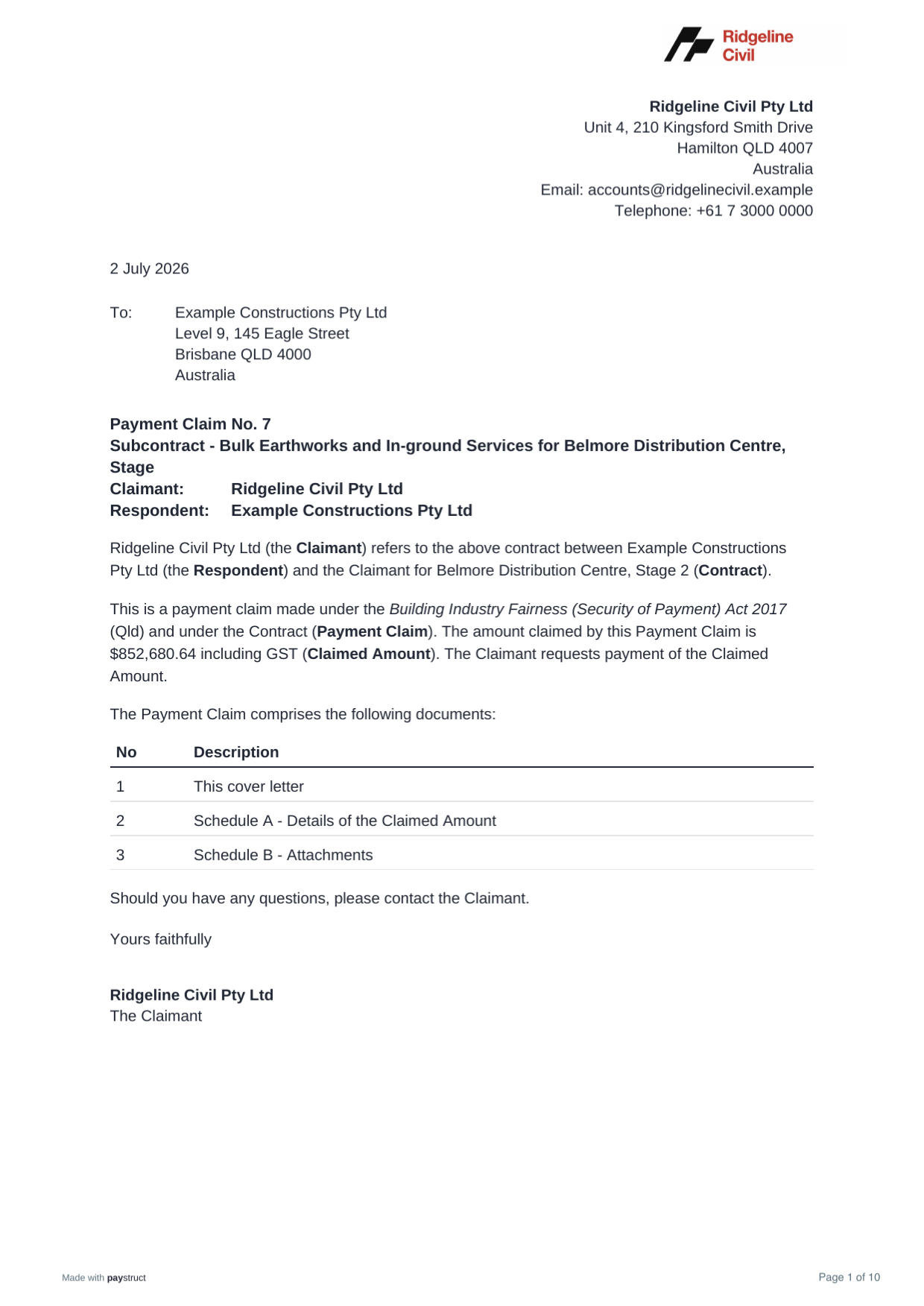
A4 portrait
Cover letter (optional)
Addressed to the respondent, on your letterhead, stating the claim number, the contract it is made under and the amount sought. It says in terms that the document is a payment claim under the Act and that payment of the claimed amount is requested, so neither limb of s 68(1) is left to inference.
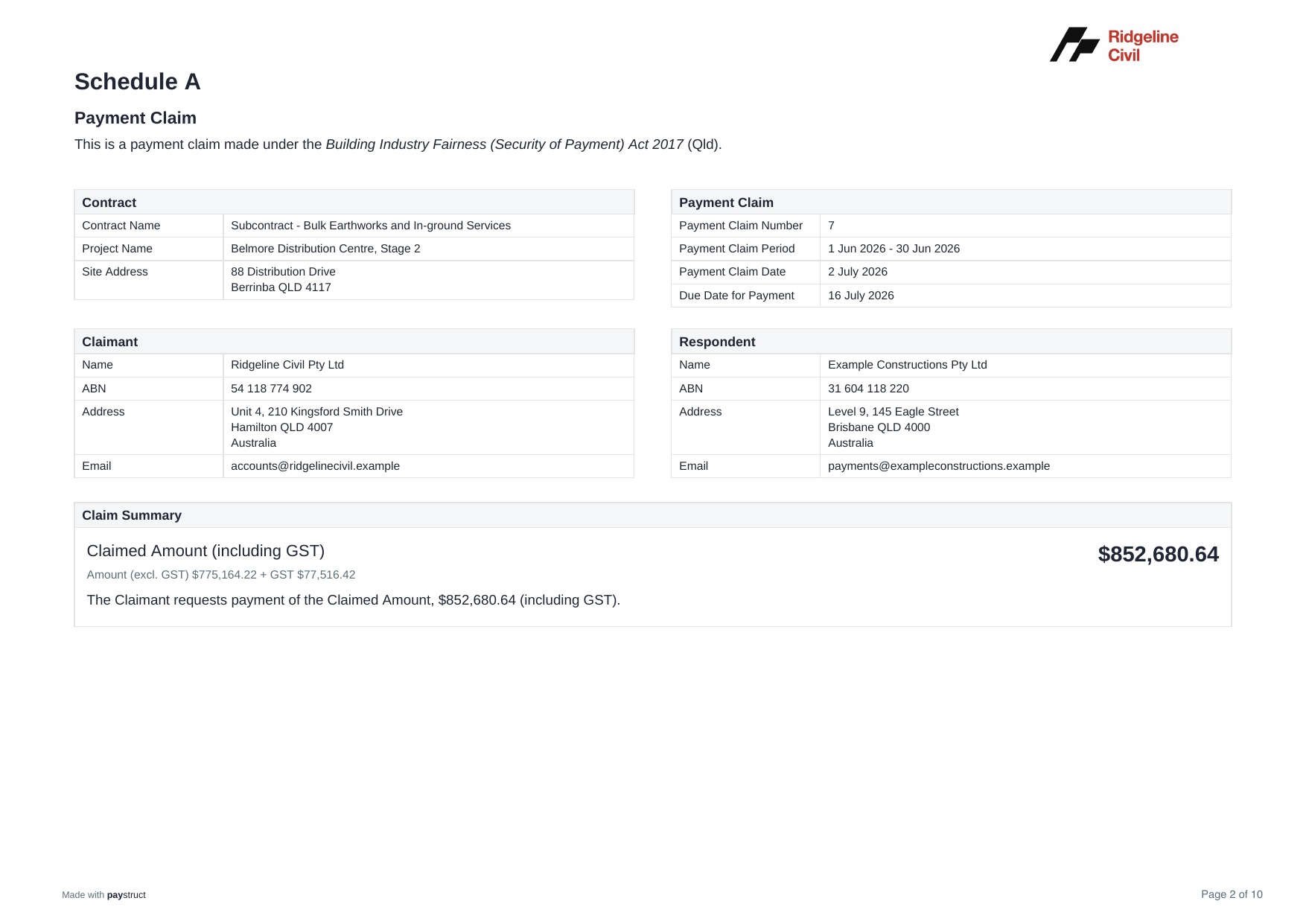
A4 landscape
Summary page
Who is claiming, who is being claimed against, and how much. Both parties in full, with ABNs and addresses for service; the contract, project and site; the claim number, period and date, and the date payment falls due. The claimed amount is stated once, including GST and with the GST shown separately, and the request for payment sits directly under it.
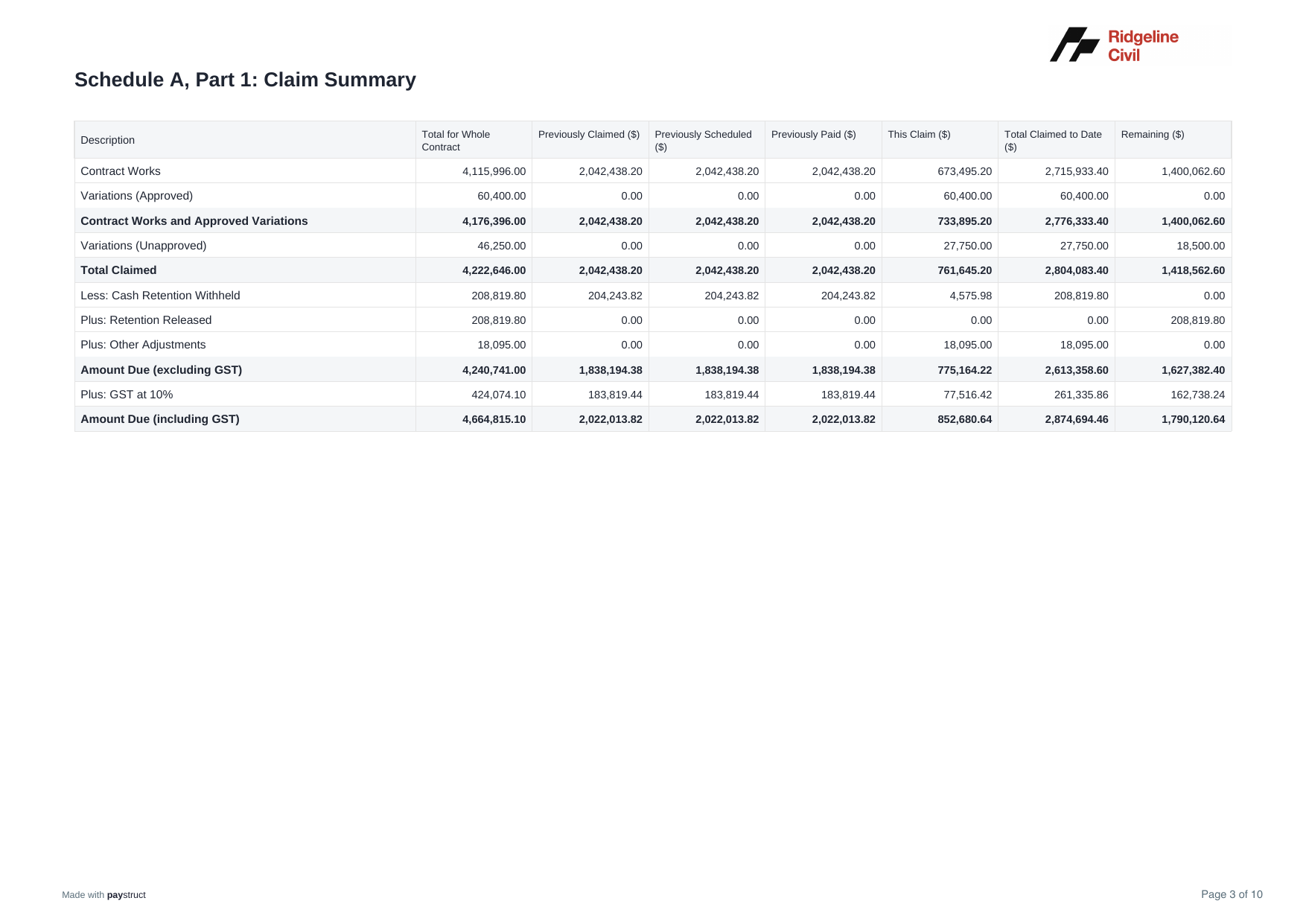
A4 landscape
Part 1: Claim summary
The arithmetic, in the order it happens. Contract works, then variations split into approved and unapproved, then retention withheld and released, then other adjustments, then GST. Every column reconciles to the parts behind it, so a respondent checking the total is checking your working, not guessing at it.
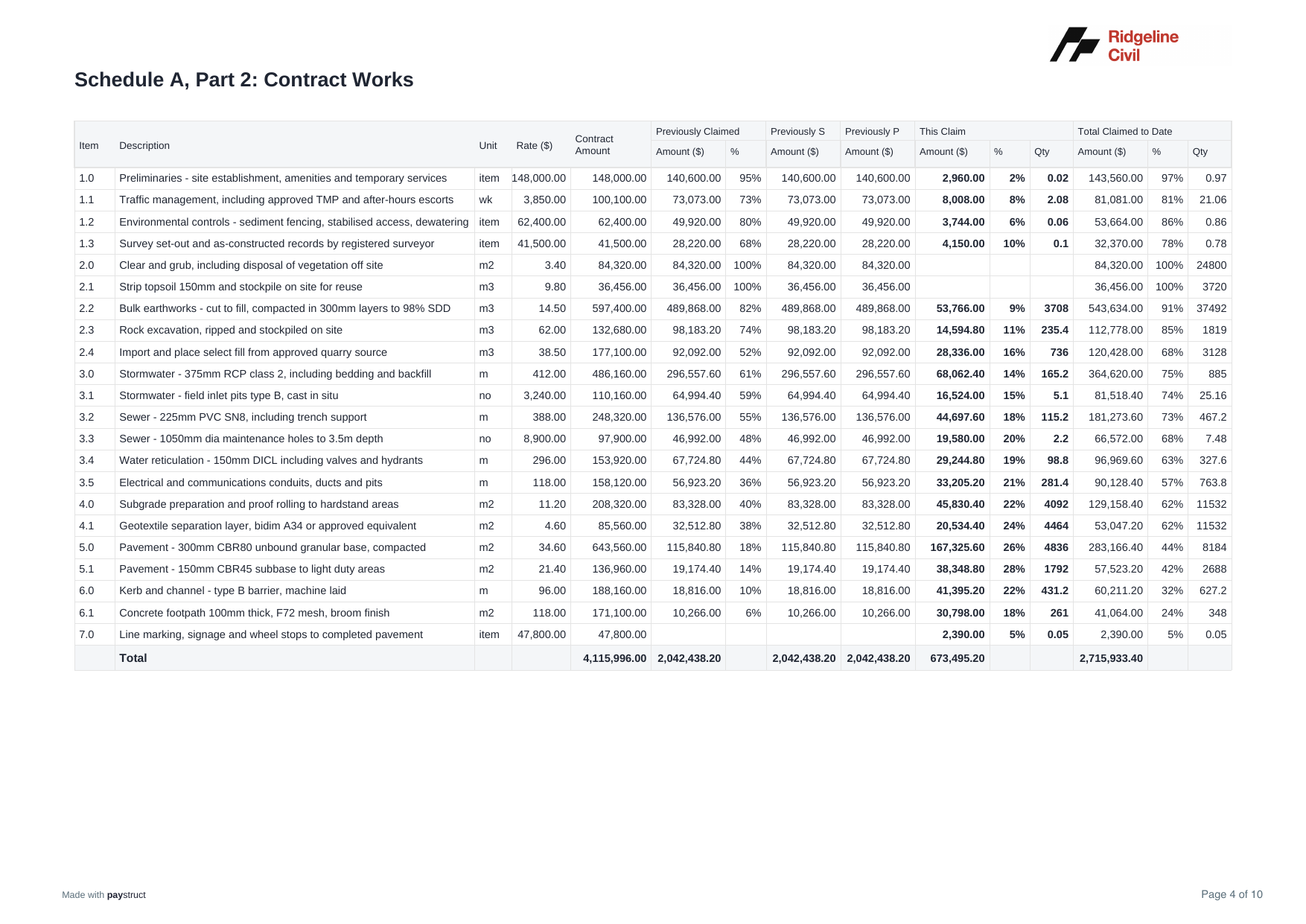
A4 landscape
Part 2: Contract works
The schedule of works as claimed, item by item. Each line carries its unit, rate and contract amount, what was previously claimed, scheduled and paid, and what is claimed now, in dollars and in quantity. Quantities matter: a line described by a percentage alone does not identify construction work.
A4 landscape
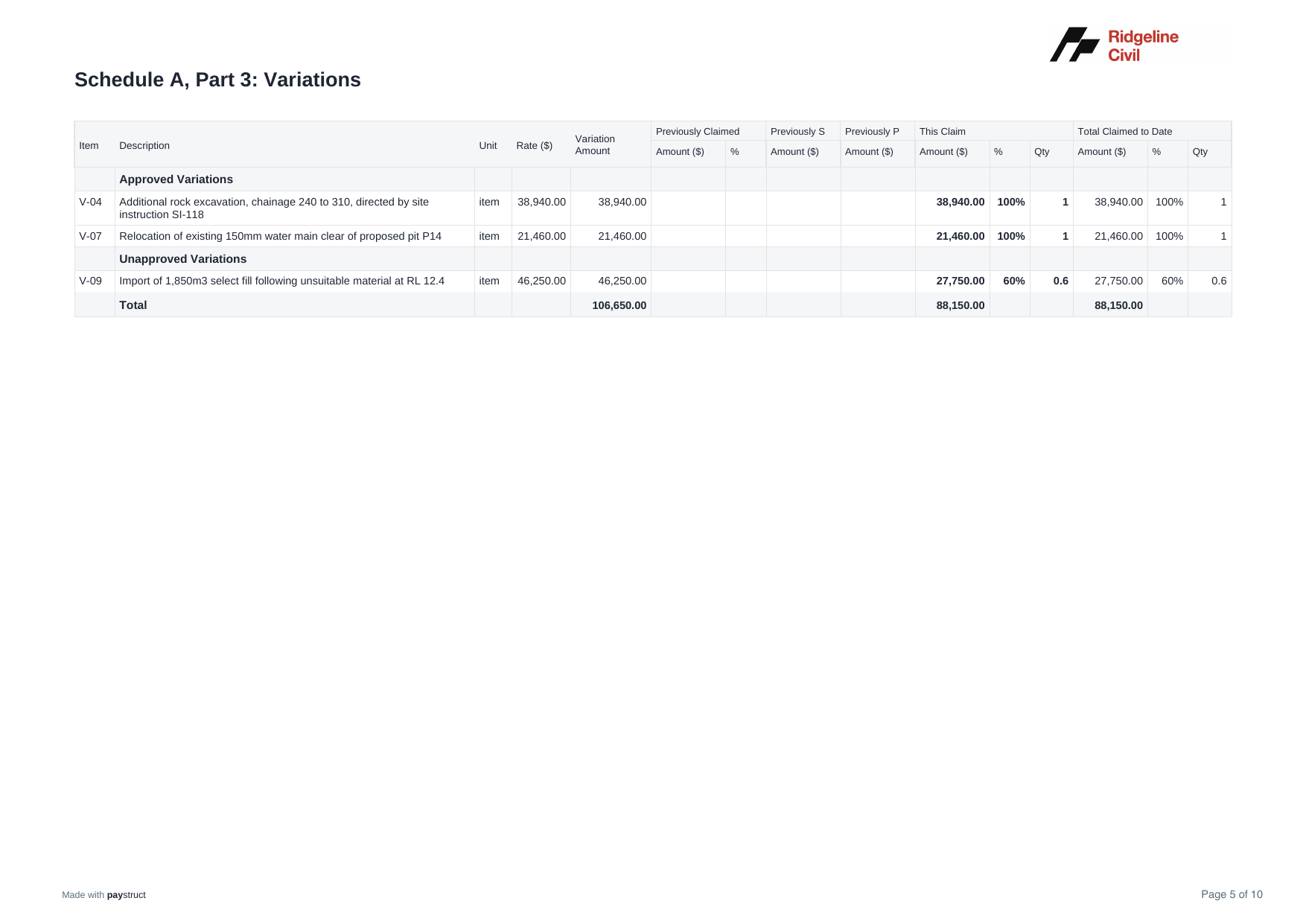
Part 3: Variations
Variations kept apart from the contract works and, within that, approved kept apart from unapproved. A respondent can accept one and dispute the other without the whole claim being in issue, and the summary carries the split through to the total.
A4 landscape
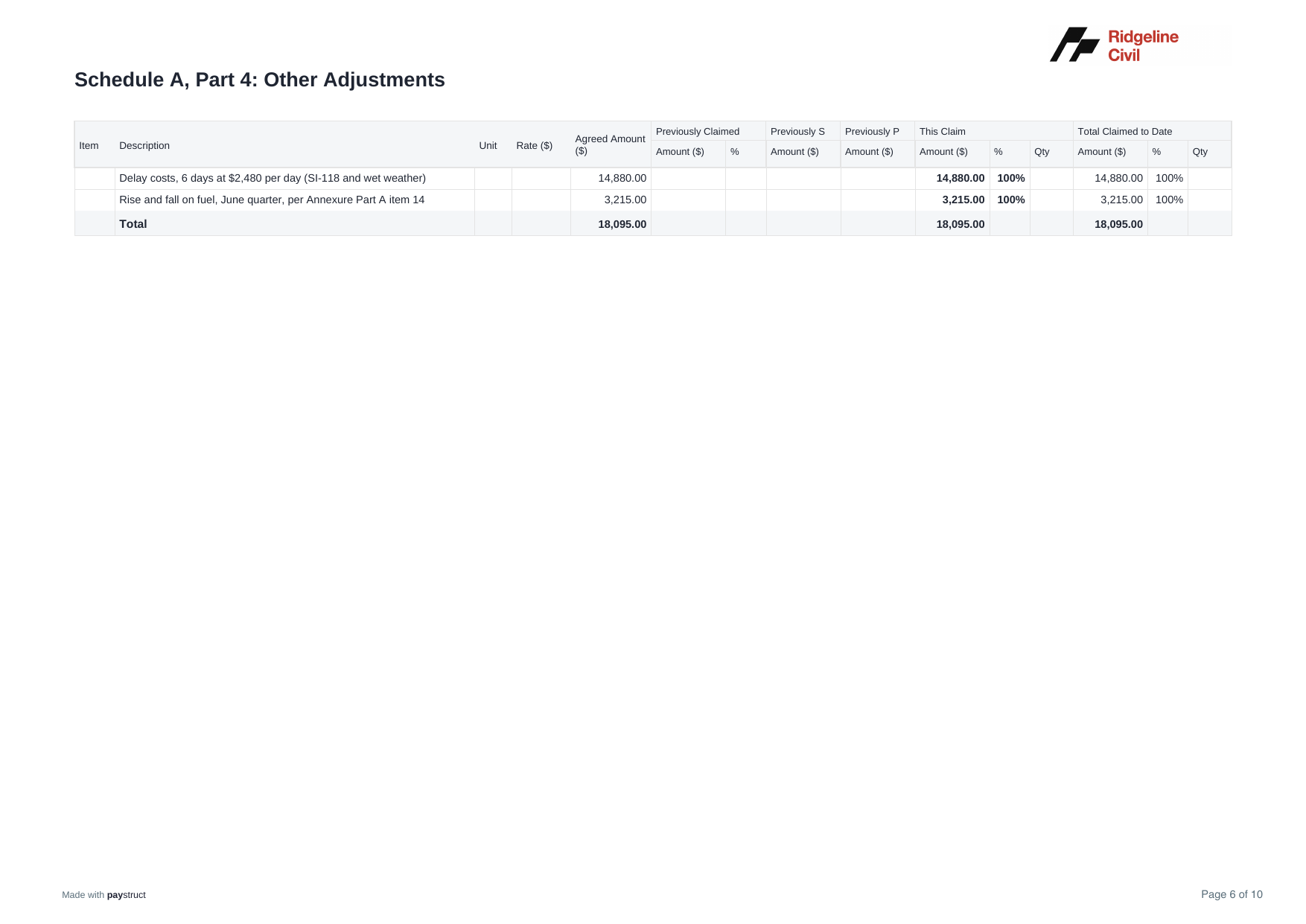
Part 4: Other adjustments (optional)
Delay costs, rise and fall, prime cost and provisional sum adjustments, back-charges: the entitlements that are neither a works item nor a variation. Stated as their own part so they are visible rather than folded into a works line where nobody finds them.
A4 landscape
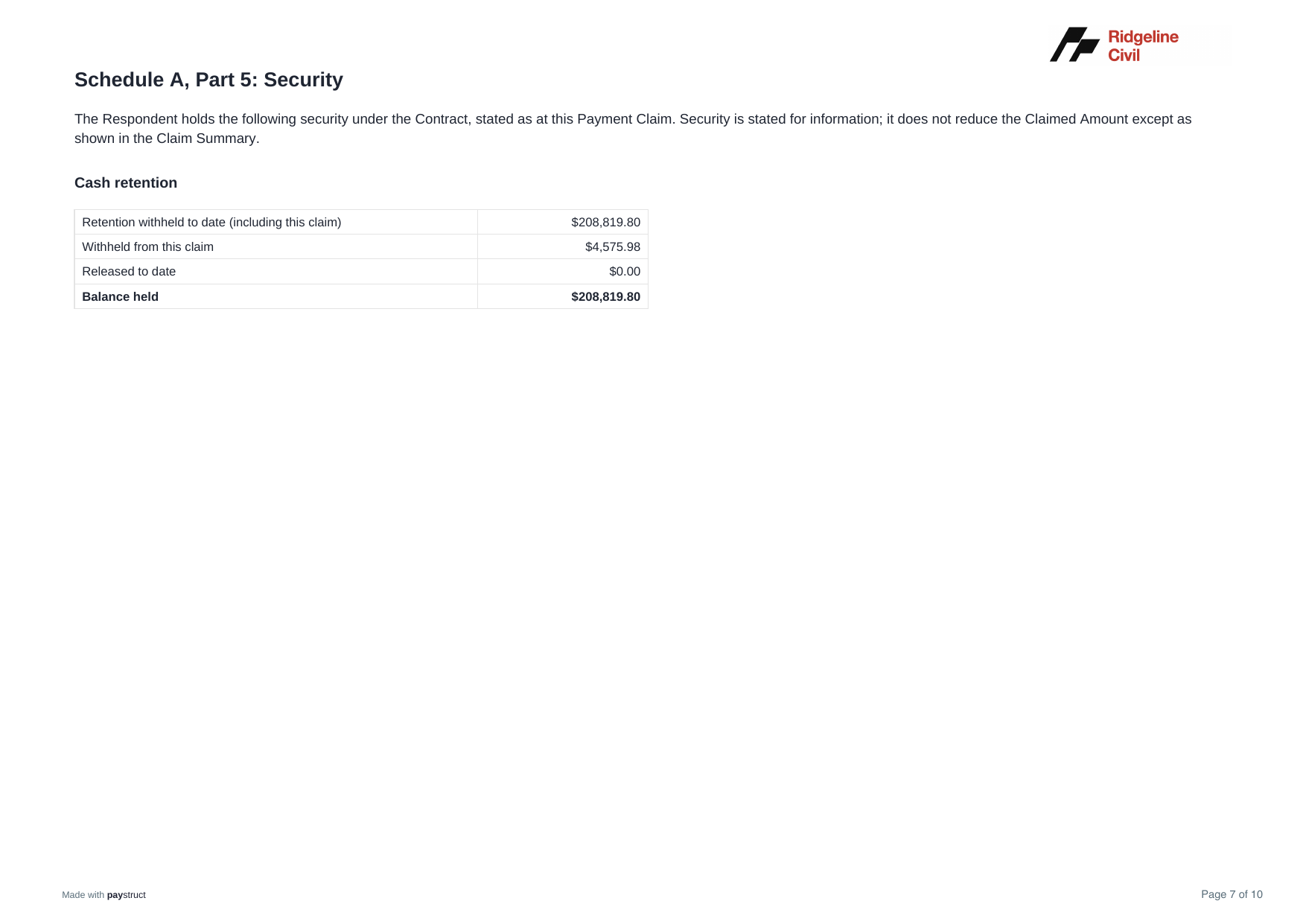
Part 5: Security (optional)
What the respondent holds and on what footing: cash retention against the cap the contract sets, and bank guarantees or bonds with their references and expiry dates. Stated for information, because security is not a deduction from the claimed amount except where the summary shows it as one.
A4 landscape
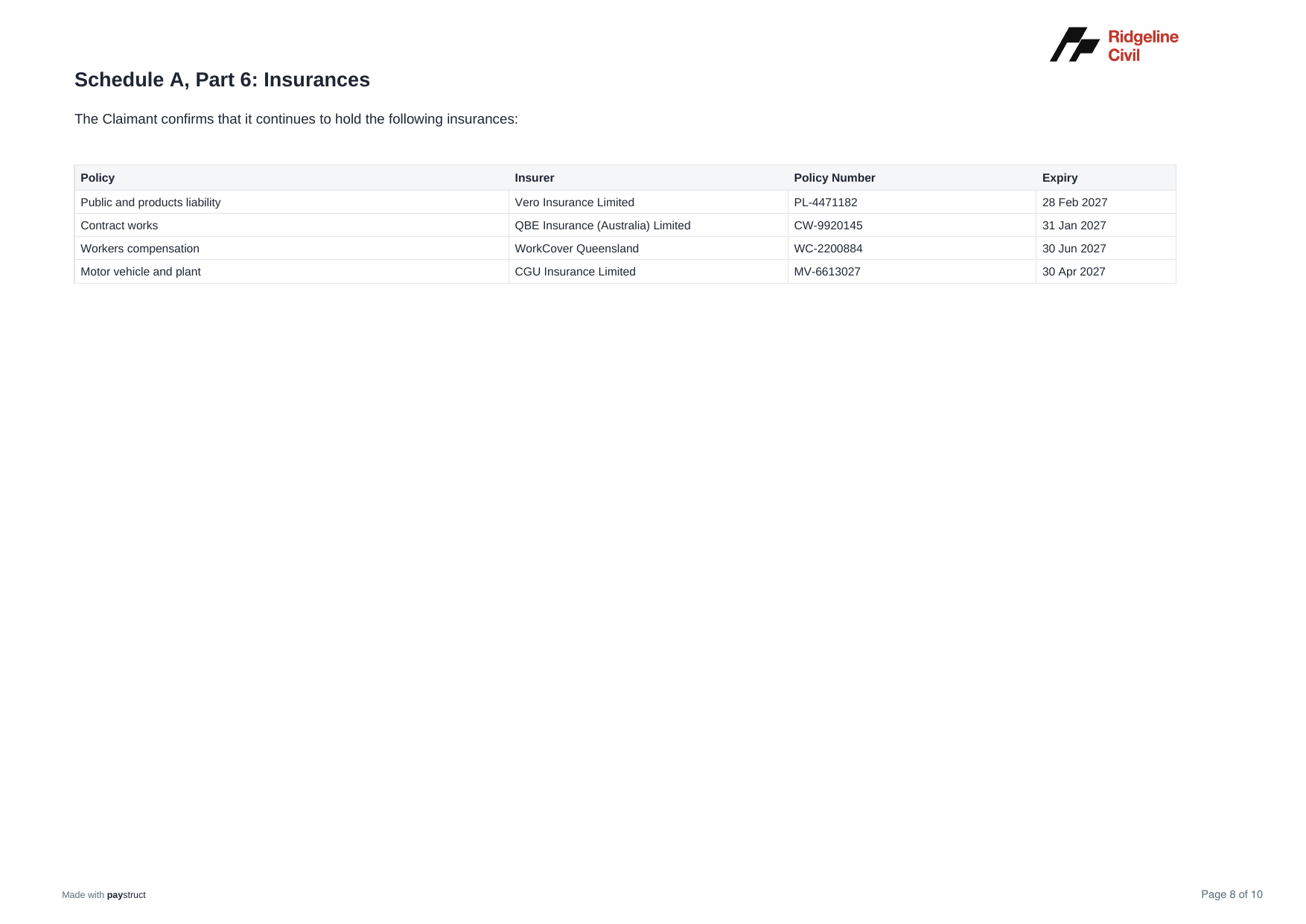
Part 6: Insurances (optional)
The policies the contract requires, with insurer, policy number and expiry date. Currency of insurance is a common condition of payment, and a certificate that lapsed mid-job is an easy reason to hold a payment that has nothing to do with the work.
A4 portrait
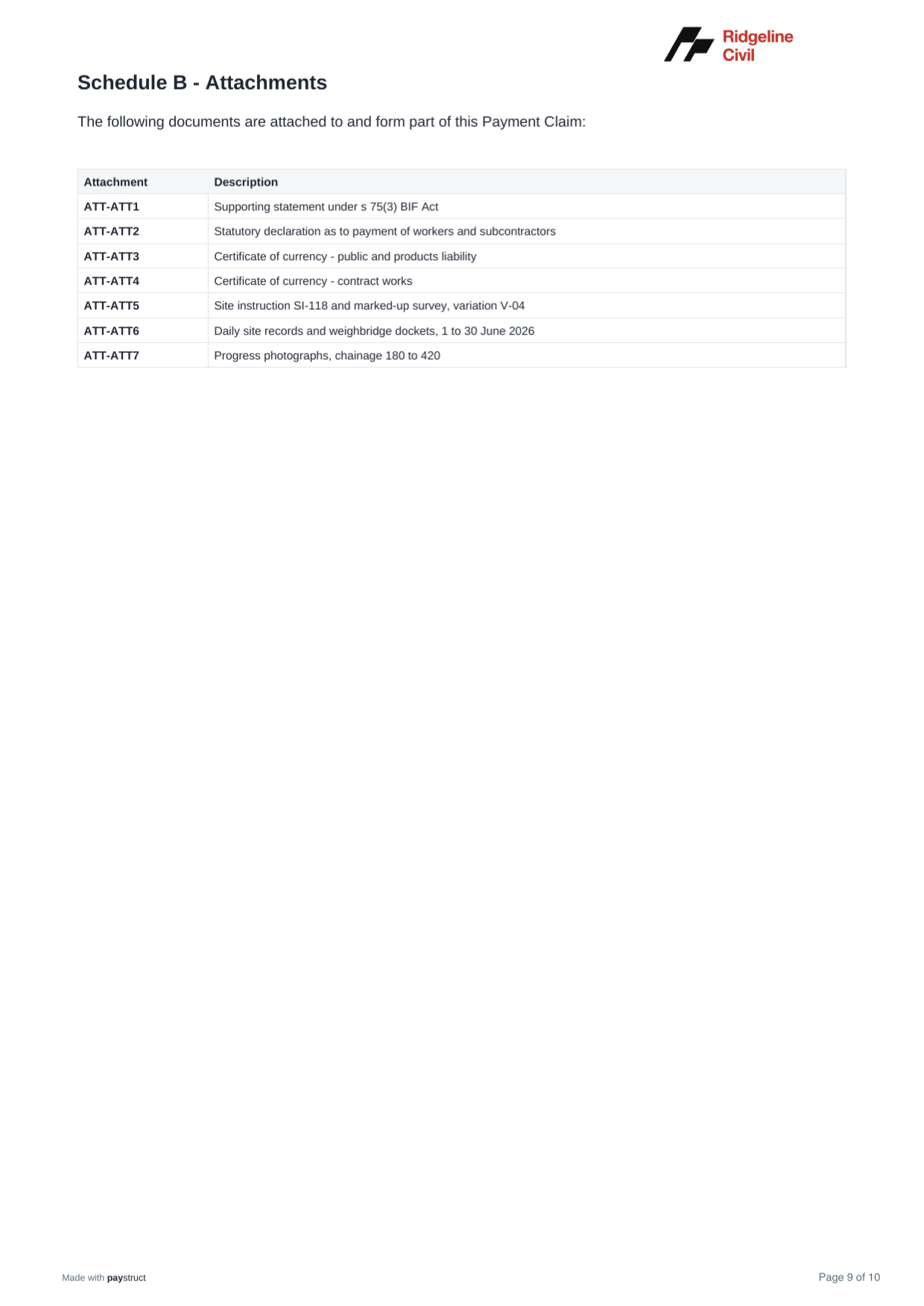
Schedule B: Attachments
Everything served with the claim, numbered and listed, and then appended behind this page as part of the same document. Attachments travel with the claim rather than sitting behind a link, so what the respondent received is the same thing you can produce later.
A4 portrait
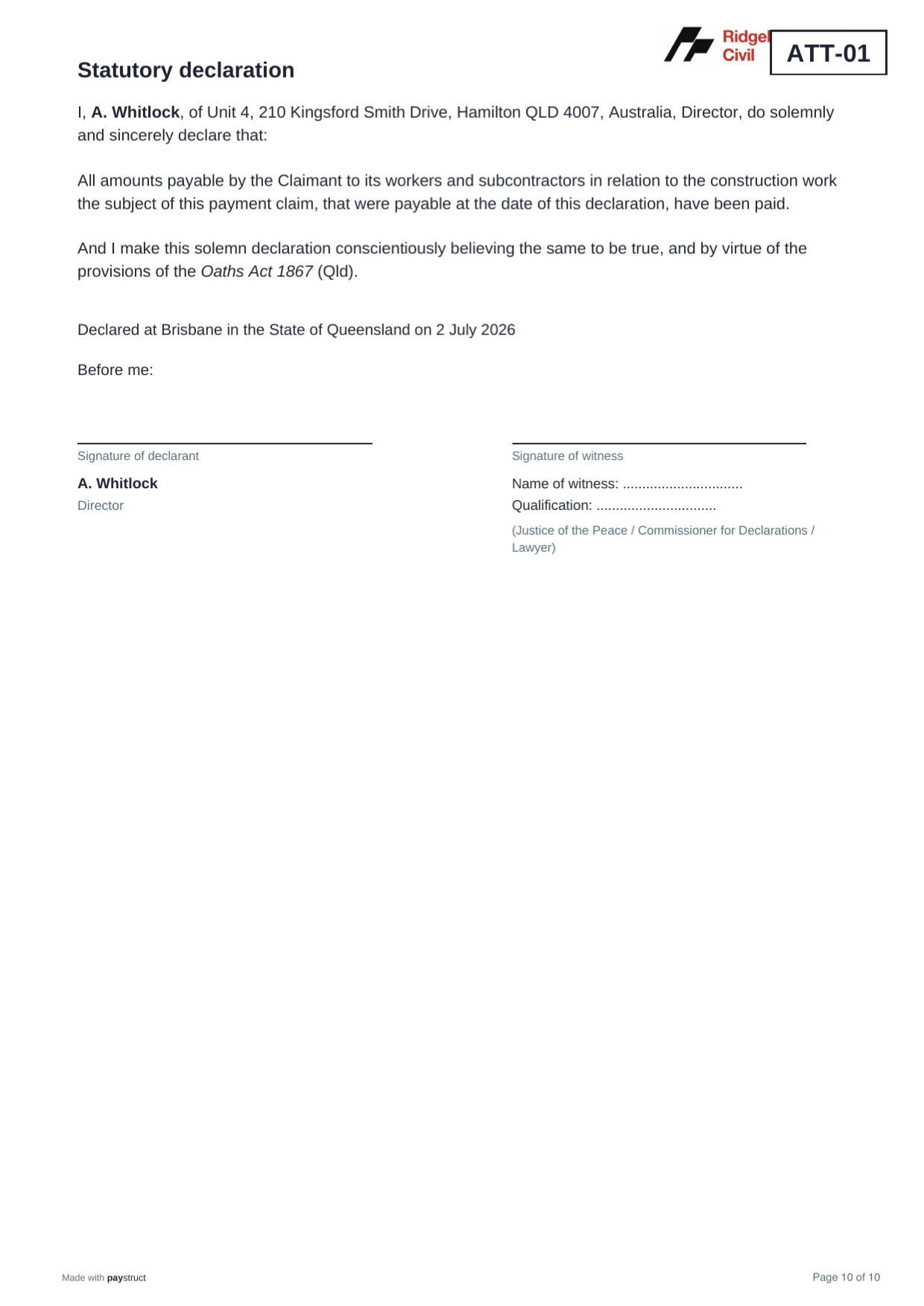
Statutory declaration (optional)
The declaration many contracts make a condition of payment: that workers and subcontractors have been paid. It ends in a jurat, with the declarant, the place and the date, and space for the witness and their qualification, because a declaration nobody witnessed is not one.
Paystruct is built for compliance
Most payment platforms in the construction market are project administration tools. Many are built to standardise claims so the party assessing them has less to do.
Paystruct is built the other way around: to help you meet the requirements of a payment claim, for the claimant’s benefit.
A reference date arises
s 75(4)A payment claim hangs off a reference date, and only one claim may be given for each one. Serve a second claim against a date already used and the whole claim can fall over, however good the work behind it.
Paystruct works the reference dates out from your contract’s own mechanism, records which ones have been claimed, and stops you serving a second claim against a date already used.
Read more about this requirementIdentify the work claimed for
s 68(1)(a)The claim must identify the construction work, or related goods and services, it relates to. A respondent has to be able to tell what they are being asked to pay for.
Line items carry quantities and units, not percentages alone, and the review flags any description that would leave a respondent guessing.
Read more about this requirementState the claimed amount
s 68(1)(b)The claim must state the amount the claimant says is payable for the progress payment.
The claimed amount is computed from the breakdown and stated on the face of the claim, with the arithmetic reconciling to the line items behind it.
Read more about this requirementRequest payment
s 68(1)(c)The claim must request payment of the claimed amount. A document that sets out a figure without asking to be paid may not be a payment claim at all.
Every claim Paystruct produces requests payment in terms, so the limb is never the thing that fails.
Read more about this requirementGiven within time
s 75(2) and (3)A claim may be given only within the period the contract allows or six months after the work was last carried out, whichever is later. A final claim runs on its own longer clock.
Paystruct counts the window from your own contract and tells you where a claim sits in it before it goes, including the longer window that applies to a final claim.
Read more about this requirementServed properly
s 102A claim only bites when it has been given to the respondent in a way the Act and the contract allow. Service is also where every later deadline is measured from.
Service methods come from the contract’s own notice provisions, and the date, method and proof are recorded against the claim.
Read more about this requirementStatutory declaration
Your contractMany contracts make a declaration about payment of workers and subcontractors a condition of payment. It is a contractual requirement, not a statutory one, but a claim can be perfectly valid under the Act and still go unpaid for want of it.
Where the contract calls for one, Paystruct produces it alongside the claim and serves it as part of the same pack.
Read more about this requirementEvidence of insurance
Your contractCurrency of insurance is a common condition of payment. Certificates expire mid-job, and a lapsed one is an easy reason to hold a payment.
Policies and expiry dates sit on the contract, and current certificates go out with the claim.
Read more about this requirementRetention and security
Your contractCash retention, bank guarantees and bonds are governed by the contract: how much is withheld, when it is released, and what has to happen first.
Retention accrues against the cap the contract sets, releases are tracked, and instruments are held against the contract with their expiry dates.
Read more about this requirementBuilt for compliance
Three things have to be right before a claim goes out: what is in it, whether it meets the requirements on its face, and when it is served. Paystruct handles each of them in turn.
Build the claim from the contract
The breakdown lives on the contract, so every claim starts from the same items and the same numbering. You enter progress; the arithmetic follows.
- Quantities and units on every line, not percentages alone
- Previously claimed, this claim and claimed to date always reconcile
- Variations, adjustments and retention carried through automatically
- Your item numbering, headings and sub-items kept intact
| Ref | Description | Qty | Progress | This claim |
|---|---|---|---|---|
| 2.0 | Bulk earthworks | 1,240 m³ | 100% | $12,410.00 |
| 3.0 | In-ground services | 318 m | 85% | $48,720.00 |
| 3.1 | Stormwater, RCP 375 | 96 m | 60% | $14,880.00 |
| 4.0 | Concrete structure | 412 m³ | 60% | $96,300.50 |
| V-02 | Rock excavation | 210 m³ | 100% | $18,890.00 |
| This claim incl. GST | $184,254.92 | |||
Check it against the requirements
Before anything is served, Paystruct works through what the legislation asks of a payment claim on its face, and shows the section it is working from.
- Reference dates worked out from the contract, and checked against earlier claims
- Timing measured in business days, on the calendar for your State
- Descriptions tested for whether they identify the work
- Anything it cannot decide is put to you rather than assumed
- Reference date 28 February is valid under the contract and has not been claimed befores 75
- Served within six months of the work being carried outs 75(4)
- Claim states the amount claimed and requests payments 68(1)
- Two lines are described by percentage alone and do not identify the works 68(1)(a)
- Supporting statement attacheds 75(3)
Know where you stand on dates
Once a claim is served the clock is running. The calendar shows what has been served, what is owed back, and how long is left to respond.
- Response window counted from the date served
- Public holidays and the December shutdown excluded
- A running position on every contract, not one claim at a time
- The date, method and proof of service kept against the claim
Set the contract up once
The contract holds the parties, the dates, the security and the breakdown. After that a claim is a period and a set of figures, not a document rebuilt from scratch.
Set up the contract
Build the claim
Check it before it goes
Serve it and record it
Our moat is serving claimants
Here is what each of the usual ways of putting a claim together does and does not do.
| Paystruct | Generic invoicing software | Claim portal run by the party paying you | Spreadsheet | |
|---|---|---|---|---|
| Built specifically for use by claimants under construction contracts | Yes✓ | No✕ | Partly– | Yes✓ |
| Built specifically for compliance with the Building Industry Fairness (Security of Payment) Act 2017 (Qld) | Yes✓ | No✕ | Partly– | No✕ |
| Manages and diarises reference dates and payment schedule due dates | Yes✓ | No✕ | No✕ | No✕ |
| Automatically standardises claims and pre-fills from current progress based on the previous claim | Yes✓ | No✕ | Yes✓ | Yes✓ |
| Reviews draft payment claims before submission and identifies potential areas for improvement | Yes✓ | No✕ | No✕ | No✕ |
| Automatically generates supporting statements and statutory declarations | Yes✓ | No✕ | No✕ | No✕ |
| Packages attachments as appendices to the payment claim rather than hyperlinks | Yes✓ | No✕ | No✕ | No✕ |
A general description of common approaches, not a statement about any particular product.